
Civil & Infrastructure | Heavy-Duty Hardstands
Heavy-Duty Hardstand Contractor | Brisbane & SEQ
A hardstand built without the right reinforcement, edge detailing, and joint design will handle light traffic fine. Put heavy trucks and plant on it repeatedly and the surface tells you exactly what was skipped.
About this service
A Heavy-Duty Hardstand Is an Engineering Scope, Not a Concreting One
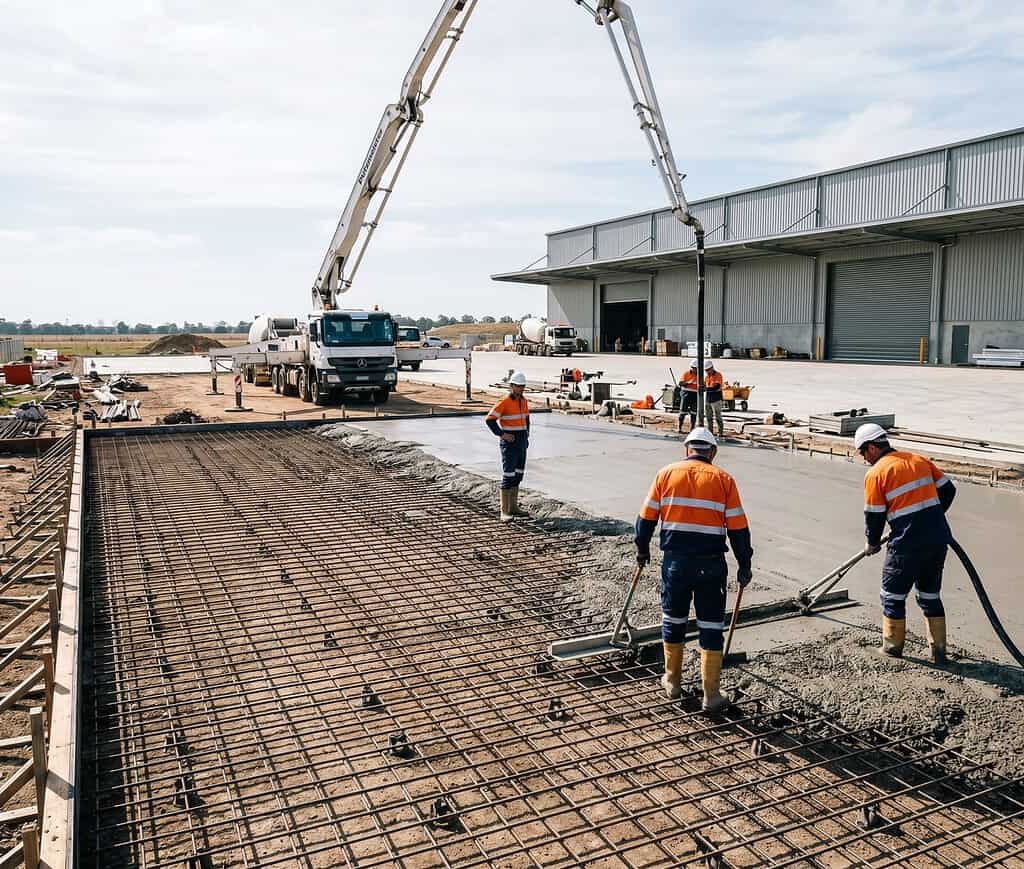
The difference between a hardstand that lasts twenty years and one that starts breaking up in three comes down to decisions made before the concrete is ordered. Slab thickness for the axle loads it will carry. Reinforcement layout to manage load distribution. Edge beam detailing to prevent corner cracking. Joint design and spacing to control where the concrete moves.
These are not details you can retrofit. They have to be right in the design, confirmed in the specification, and executed correctly on the day of the pour.
QCG delivers heavy-duty hardstands for industrial operators, logistics facilities, port and transport infrastructure, and civil programmes across Brisbane and South East Queensland. Every hardstand scope starts with a review of the load requirements and finishes with a surface that is engineered to handle them.
Heavy-duty hardstands at a glance
What QCG Delivers on Heavy-Duty Hardstand Scopes
How we work
How QCG Approaches Heavy-Duty Hardstand Delivery
Load requirements established before design is locked
Before pricing, we establish the axle loads, plant weights, and traffic patterns the hardstand will carry. Slab thickness, reinforcement layout, and edge beam dimensions follow from that. Not from a standard residential spec applied to an industrial scope.
Subbase and preparation reviewed before reinforcement goes in
Subgrade conditions directly affect hardstand performance. We review subbase compaction and drainage before reinforcement is installed. If conditions require adjustment, it is identified before the pour, not after the surface starts moving.
Reinforcement installed and inspected as a documented hold point
Reinforcement placement, chair heights, and coverage are inspected against the engineering drawings before concrete is placed. That inspection is signed off in writing. The pour does not proceed until it is closed.
Joints designed, set out, and cut to specification
Contraction joints, isolation joints, and construction joints are set out before the pour and cut within the required timeframe after placement. Joint spacing and layout are designed to control where the concrete moves, not left to chance.
Surface finished to the operational requirement
Power float finish for forklift and plant traffic. Broom finish where slip resistance is required. The finish is matched to how the hardstand will actually be used.
Load requirements established before design is locked
Before pricing, we establish the axle loads, plant weights, and traffic patterns the hardstand will carry. Slab thickness, reinforcement layout, and edge beam dimensions follow from that. Not from a standard residential spec applied to an industrial scope.
Subbase and preparation reviewed before reinforcement goes in
Subgrade conditions directly affect hardstand performance. We review subbase compaction and drainage before reinforcement is installed. If conditions require adjustment, it is identified before the pour, not after the surface starts moving.
Reinforcement installed and inspected as a documented hold point
Reinforcement placement, chair heights, and coverage are inspected against the engineering drawings before concrete is placed. That inspection is signed off in writing. The pour does not proceed until it is closed.
Joints designed, set out, and cut to specification
Contraction joints, isolation joints, and construction joints are set out before the pour and cut within the required timeframe after placement. Joint spacing and layout are designed to control where the concrete moves, not left to chance.
Surface finished to the operational requirement
Power float finish for forklift and plant traffic. Broom finish where slip resistance is required. The finish is matched to how the hardstand will actually be used.
Why QCG
Why Industrial Operators and Civil Contractors Choose QCG for Heavy-Duty Hardstands
Load requirements drive every design decision
Slab thickness, reinforcement layout, edge beam dimensions, and joint spacing are all specified against the actual loads the hardstand will carry. A standard spec applied to a heavy industrial scope is how surfaces fail early.
Joint design is treated as engineering, not finishing
Contraction joint layout, spacing, and timing are designed before the pour and executed to specification. Poorly designed or poorly timed joints are the most common cause of hardstand surface failure under repeated heavy loading.
RPEQ engineering partnership for load-rated and certified scopes
For hardstands requiring structural sign-off or engineering certification, QCG delivers in coordination with RPEQ-registered engineers. Load calculations, design compliance, and certification are managed as part of delivery.
You are not the first person to call about a hardstand that failed
We have seen what happens when the reinforcement is undersized, the joints are wrong, or the subbase was not checked before the pour. That experience is built into how we price, plan, and deliver every heavy-duty hardstand scope we take on.
Load requirements drive every design decision
Slab thickness, reinforcement layout, edge beam dimensions, and joint spacing are all specified against the actual loads the hardstand will carry. A standard spec applied to a heavy industrial scope is how surfaces fail early.
Joint design is treated as engineering, not finishing
Contraction joint layout, spacing, and timing are designed before the pour and executed to specification. Poorly designed or poorly timed joints are the most common cause of hardstand surface failure under repeated heavy loading.
RPEQ engineering partnership for load-rated and certified scopes
For hardstands requiring structural sign-off or engineering certification, QCG delivers in coordination with RPEQ-registered engineers. Load calculations, design compliance, and certification are managed as part of delivery.
You are not the first person to call about a hardstand that failed
We have seen what happens when the reinforcement is undersized, the joints are wrong, or the subbase was not checked before the pour. That experience is built into how we price, plan, and deliver every heavy-duty hardstand scope we take on.
Right fit
Who QCG Works With on Heavy-Duty Hardstand Projects
Industrial Operators and Facilities Managers
Operating a facility where heavy trucks, forklifts, or plant move across your hardstand daily and you need a surface built to handle it long term?
- Load requirements reviewed before reinforcement and thickness are specified
- Edge beam detailing and joint design engineered to prevent the failure modes you have probably seen before
- Mix design matched to the operational environment
- Surface ready to carry the loads from day one
Civil Contractors and Principal Contractors
Need a concrete subcontractor to deliver a heavy-duty hardstand scope within your civil or industrial programme?
- Scope reviewed against engineering drawings before pricing
- Pour sequence and programme coordination confirmed in writing before mobilisation
- ITP documentation and hold point inspections managed as standard
- Variations in writing before additional work proceeds
Logistics, Transport, and Port Operators
Managing a logistics or port facility where surface performance under continuous heavy vehicle movement is non-negotiable?
- Axle load ratings and traffic patterns inform every design decision
- Joint detailing specified to handle the turning and braking forces your operation generates
- RPEQ engineering partnership available for certified and load-rated hardstand scopes
- Full documentation pack at handover
Got a heavy-duty hardstand scope to discuss? Send through the details and the team will come back to you.
Recent work
RPEQ-Governed Concrete Projects Delivered by QCG
We let the work speak. Below is a selection of recent commercial, civil, and residential concrete projects delivered across the Sunshine Coast and South East Queensland.
Commercial
Industrial Warehouse Slab
Sunshine Coast — 2,400m² reinforced slab pour, flatness tolerance to specification, staged pour sequencing coordinated with head contractor program.
View Project
Civil
Civil Infrastructure Pour
Sunshine Coast — 2,400m² reinforced slab pour, flatness tolerance to specification, staged pour sequencing coordinated with head contractor program.
View Project
Residential
Residential Driveway & Slab
Sunshine Coast — 2,400m² reinforced slab pour, flatness tolerance to specification, staged pour sequencing coordinated with head contractor program.
View Project
Frequently Asked Questions | Heavy-Duty Hardstands
What makes a heavy-duty hardstand different from a standard concrete slab?
A heavy-duty hardstand is engineered specifically for repeated loads from trucks, plant, and heavy vehicles. Slab thickness, reinforcement, edge beam detailing, and joint design are all specified against the actual axle loads and operational demands of the facility, not a generic residential or light commercial specification.
How thick should a heavy-duty hardstand be?
Thickness depends on the axle loads, subgrade conditions, and operational requirements of the specific site. Light industrial hardstands typically start at 150mm. Heavy plant and truck hardstands may require 200mm or more with thickened edge beams. Load requirements are reviewed before thickness is specified.
What causes heavy-duty hardstands to fail under load?
The most common causes are insufficient slab thickness for the loads carried, undersized or incorrectly placed reinforcement, poorly designed or mistimed joints, and inadequate subbase preparation. None of these are visible at handover. They appear when the surface is under operational load.
What joint detailing does QCG use on heavy-duty hardstands?
QCG designs and installs contraction joints, isolation joints, and construction joints to control where the concrete moves under load and temperature change. Joint layout and spacing are specified to the engineering drawings and cut within the required timeframe after placement.
Does QCG deliver RPEQ-certified heavy-duty hardstands?
Yes. For hardstand scopes requiring load-rated certification or structural engineering sign-off, QCG delivers in coordination with RPEQ-registered engineers. Engineering documentation and certification are included in the project handover pack.
What areas does QCG service for heavy-duty hardstand works?
QCG’s primary service area for heavy-duty hardstands covers Brisbane, the Sunshine Coast, and South East Queensland. Projects outside this area are considered depending on scope and programme.
Accreditations and compliance
QBCC Licence
15606141
Public Liability Insurance
$20M
Workers Compensation
Current
AS 3600
Compliant delivery on all heavy-duty hardstand pours
RPEQ engineering partnership
Delivered in coordination with RPEQ-registered engineers where certification is required
Safe Work Method Statements
Site-specific SWMS prepared for every hardstand scope
ITP-Driven Delivery
Inspection and Test Plan managed on every hardstand scope
Our Certifications





Get In Touch
Ready to Discuss Your Hardstand Scope?
Whether you are planning a new industrial hardstand or replacing a surface that has not held up, the team can talk through the load requirements, design approach, and what the scope involves. Get in touch to start the conversation.
QCG delivers heavy-duty hardstand works across Brisbane, the Sunshine Coast, and South East Queensland.